Chapter 1: Outside-of-School Experiences Increase Children’s Interest in STEM
Why Are Afterschool STEM Programs Important?
Children only spend 20% of their time learning in formal classroom settings, with 80% of their learning taking place in informal learning environments. Informal settings range from afterschool and summer programs to libraries, museums, science centers, community centers, and the home.
In contrast to classrooms, afterschool STEM (Science, Technology, Engineering, and Math) programs aim to provide children with:
- High engagement via more hands-on, social, or extended opportunities to pursue learning
- Relevant ways to connect learning to their everyday experiences and interests
- Authentic science explorations that use the language and tools of STEM subjects
By giving children positive afterschool STEM experiences, you have the potential to impact how they learn and develop interest in STEM subjects, in the short- and long-term. Building early interest in STEM is important because it:
- Enables children to see themselves as the kind of person who is capable of “doing science and math.”
- Creates STEM pathways that encourage children to select more STEM activities during elementary school and, perhaps, beyond into future careers.
Chapter 1 Video Series
Hands-On Activities to Spark Children's Interest in STEM
Increasing Equitable Access to STEM Experiences and Content
Building Important Elementary STEM Knowledge and Skills
How Can Afterschool Programs Spark STEM Interest?
Let’s consider how children’s STEM interest can build with an example from a program called Afterschool Science, Technology, Engineering, Arts, and Math (A’STEAM). The Children’s Museum Houston has delivered the A’STEAM program in more than 100 afterschool settings, including through research studies with the Children’s Learning Institute. Effective afterschool programs spark STEM interest as children realize the following key factors (Afterschool Alliance, 2016).
Download the Traits of Scientists and Engineers poster!
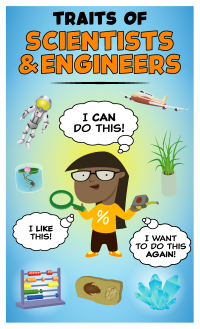
I Like to Do This
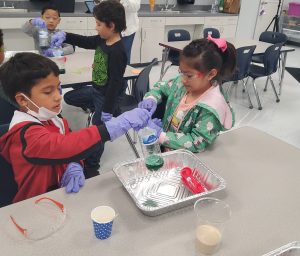
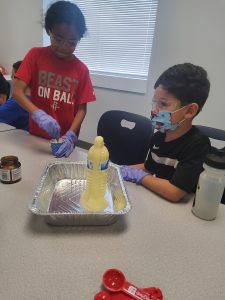
A’STEAM activities offer many opportunities for children to incorporate their interests and home experiences with STEM learning. For example, children create a salt painting of any image or design of their choosing, to learn about the difference between a mixture and a solution. After building a water filtration device, they are prompted to consider what other filtration devices they could build with household items. For children, these types of connections can:
- Highlight how the STEM content is relevant to their everyday lives
- Increase their engagement in the current activity
- Drive their motivation for STEM learning in other contexts
Further, incorporating children’s interests helps broaden their ideas of what counts as STEM: beyond rote lab experiments or writing code for an app, STEM activities take place all around them. In the longer-term, children may then consider how to apply STEM learning to their everyday lives and solve problems in their home or broader community.
See Family Engagement in STEM for more details on engaging families in extending children’s STEM learning by making connections at home.
I Can Do This
Afterschool STEM experiences have the potential to strengthen children’s conceptual understanding and STEM-related skills. For example, building and flying a kite in A’STEAM can help a child explain aerodynamic concepts (such as drag, lift, and gravity) in the classroom. This is known as transfer: when children apply what they learn about in one setting to a different setting. Being engaged in a learning experience, such as during afterschool activities, can lead to increased:
- Transfer of science and math knowledge, such as specific facts and information
- Transfer of the practices and skills of scientists and engineers, such as questioning, investigating, and redesigning
- Transfer of cross-cutting concepts, such as recognizing patterns or how systems work
See the What are Key Aspects of STEM Learning section on this page for more details on how children learn science in elementary school.
I Want to Do This Again
Hands-on, inquiry-focused STEM activities also allow children to use the same language and tools as scientists and engineers. A’STEAM scientific experiments connect to children’s interests and experiences as described above, but children also closely observe their experimental results and ask questions based on what they notice. Engineering design challenges prompt learners to also redesign what they have built based on their observations. By taking on these kinds of authentic practices, children engage in a learning experience that accurately reflects how scientists and engineers approach their work, but can also lead to increased long-term motivation to pursue STEM activities and careers.
How Can Afterschool Programs Increase Equitable Access to STEM?
There is a wealth of research that shows how positive STEM learning experiences, especially outside of school, can lead to shifts in how children see themselves as belonging and identifying with those subjects. Feelings of belonging further contribute to children’s motivation to learn and continued engagement with the STEM subjects.
These factors are especially important for children from under-represented backgrounds, by providing a broadened sense of both who does STEM and what counts as STEM activities.
- Afterschool programs play an important role, given that children from populations that are historically underrepresented in STEM are more likely to participate in afterschool programs than others: 24 percent of African-American, 21 percent of Hispanic and 16 percent of Native American children attend afterschool programs, compared to the national average of 15 percent (Afterschool Alliance, 2009).
- Afterschool programs can also use English learners’ native languages when possible. For example, if a facilitator speaks Spanish, they can name key STEM vocabulary in English and Spanish. Regardless of whether the educator is bilingual, they can encourage peers to talk to one another freely in their home languages. This type of use of multiple languages shows that STEM is for everyone.
What Are Key Aspects of STEM Learning?
When facilitating, designing, or selecting an afterschool STEM program, consider how it aligns with national and local standards for science and math learning. By using afterschool approaches that align with what children are expected to learn in school, you are more likely to impact learners’ learning. For example, the National Research Council’s Framework for K-12 Science Education was developed based on research and evidence to best support K-12 learners’ science learning. The Framework recommends that science instruction is structured in three dimensions, all of which are relevant to afterschool settings:
Disciplinary Core Ideas
The content of what learners learn in science is defined by the second dimension of Disciplinary Core Ideas. These are structured into the subject areas of Life Science, Earth & Space Sciences, Physical Science, & Engineering, Technology and the Application of Science.
- Afterschool activities can help children connect scientific experiments or engineering design challenges to Disciplinary Core Ideas by teaching key vocabulary and concepts.
- Actively encourage children to make sense of what they are doing in an afterschool activity, in order to extend their learning and make conceptual connections.
- To help learners apply what they have learned to a new context, ask questions such as “How does this activity connect to something you have done at home or in school?”
Science & Engineering Practices
The main innovation of the Framework’s approach is that learners learn science by “doing” science and authentically incorporating the steps of the engineering design process. The practices, many of which are leveraged in afterschool activities, are listed in the table below.
- When facilitating afterschool activities, pay attention to which practices children are undertaking and name the practices for students. For example, you could praise students by saying, “You are explaining your ideas and using evidence.”
- Pointing out these practices can help children recognize their activities as similar to those of scientists and engineers, as well as promote their development of STEM-related identities.
Crosscutting Concepts
Finally, the third dimension recognizes that there are broad themes of conceptual reasoning that bridge across different subject areas. The Crosscutting Concepts are on the right side of the table.
- Help children begin to consider these sophisticated concepts with questions such as “What patterns have you noticed?” or “How do you think this has changed over time?”
- In elementary classrooms, children are introduced to and build on these themes as they take on practices and learn content. You can deepen children’s recognition of crosscutting concepts by emphasizing when the themes show up in afterschool activities.
Science & Engineering Practices
- Asking Questions and Defining Problems
- Developing and Using Models
- Planning and Carrying Out Investigations
- Analyzing and Interpreting Data
- Using Mathematics and Computational Thinking
- Constructing Explanations and Designing Solutions
- Engaging in Argument from Evidence
- Obtaining, Evaluating, and Communicating Information
Crosscutting Concepts
- Patterns
- Cause and Effect
- Scale, Proportion, and Quantity
- Systems and System Models
- Energy and Matter
- Structure and Function
- Stability and Change
References
Afterschool Alliance (2016, December). The impact of afterschool STEM: Examples from the field. http://afterschoolalliance.org/documents/AfterschoolSTEMImpacts2016.pdf
Bell, P., Bevan, B. (2015). What is the role of informal science education in supporting the vision for K-12 science education? STEM Teaching Tools Practice Brief 38. https://stemteachingtools.org/brief/38
Bell, P., Lewenstein, B., Shouse, A. W., & Feder, M. A. (2009). Learning science in informal environments: People, places, and pursuits. Washington, D.C.: National Academies Press.
Bell, P., Sanchez, A., Ventura, M. (2019). How can science instruction leverage and develop learner interests? Short answer: In so many different ways! STEM Teaching Tools Practice Brief 58 https://stemteachingtools.org/brief/58
Bransford, J., Stevens, R., Schwartz, D., Meltzoff, A., Pea, R., Roschelle, J., Vye, N., Kuhl, P., Bell, P., Barron, B., Reeves, B., & Sabelli, N. (2006). Learning Theories and Education: Toward a Decade of Synergy. In P. A. Alexander & P. H. Winne (Eds.), Handbook of educational psychology (pp. 209–244). Lawrence Erlbaum Associates Publishers.
Krishnamurthi, A., Ballard, M., & Noam, G. G. (2014). Examining the impact of afterschool STEM programs. http://www.afterschoolalliance.org/ExaminingtheImpactofAfterschoolSTEMPrograms.pdf
National Academies of Sciences, Engineering, and Medicine. 2018. How People Learn II: Learners, Contexts, and Cultures. Washington, DC: The National Academies Press. https://doi.org/10.17226/24783
National Research Council. (2012). A Framework for K-12 Science Education: Practices, Crosscutting Concepts, and Core Ideas. Washington, D.C.: National Academies Press.
Nolan, C. (2015). Getting their hands dirty: Engaging learners in authentic science practices outside the classroom. STEM Teaching Tools Practice Brief 20. https://stemteachingtools.org/brief/20
Schwarz, C. V., Passmore, C., & Reiser, B. J. (2017). Helping learners make sense of the world using next generation science and engineering practices. NSTA Press.
Stevens, R. Bransford, J. & Stevens, A. (2005). The LIFE Center Lifelong and Lifewide Learning Diagram. LIFE Center. http://life-slc.org
Afterschool and Schoolage STEM Toolkit
Return to the toolkit.
