Kindergarten
Guide to Rating Anchors
The following anchors will be used to describe children’s early literacy/reading skills:
- Masters Grade Level: performance in this category indicates that the student is expected to succeed in the next grade with little or no academic intervention.
- Meets Grade Level: performance in this category indicates that students have a high likelihood of success in the next grade but might need some short-term, targeted academic intervention.
- Approaches Grade Level: performance in this category indicates that students are likely to succeed in the next grade with targeted academic intervention.
- Did Not Meet Grade Level: performance in this category indicates that students are unlikely to succeed in the next grade without significant, ongoing academic intervention.
Explanation of Scoring
In most of the Dyslexia Referral Checklist items, there are four possible ratings (i.e., Did not meet grade level expectations, Approaches grade level expectations, Meets grade level expectations, Masters grade level expectations).
- Ratings of “Did not meet grade level expectations” receive a risk level score of 2.
- Ratings of “Approaches grade level expectations” receive a risk level score of 1.
- Ratings of “Meets or Masters grade level expectations” each receive a risk level score of 0.
A similar strategy is used in the 2 questions in the Observable section. These 2 questions utilize different anchors (i.e., Never, Rarely, Often, Almost Always).
- Ratings of “Almost Always” receive a risk level score of 2.
- Ratings of “Often” receive a risk level score of 1.
- Ratings of “Rarely” or “Never” receive a risk level score of 0.
Items that document the results of screening assessment are scored differently than the previous items.
- “High Risk Observed” scores receive a risk level score of 2. High Risk is defined as when a student has not responded to Tier 1 or Tier 2 intervention support. At this point, the classroom teacher/referral committee might be considering pursuing an evaluation under IDEA or Section 504.
- “Some Risk Observed” scores receive a risk level score of 1. In this case, students have not responded as well as classmates to Tier 1 instruction and would likely benefit from Tier 2 intervention and ongoing monitoring.
- Ratings of “No Risk” or “Monitoring (Tier 1)” and “Not Assessed” will receive a risk level score of 0.
(Note: The “Not Assessed” rating was included because it is recognized that not all universal screening/progress monitoring measures evaluate all domains. Not Assessed ratings might also represent that a classroom teacher did not complete universal progress monitoring measures for some reason (e.g., sensory impairment, behavioral difficulties, etc.). In short, the Dyslexia Referral Committee, teacher, and school administrators (e.g., Special Ed Coordinator) on each campus will be responsible for evaluating all data to determine if a more comprehensive evaluation is required. The Dyslexia Referral Checklist should be seen as one piece of information to help determine if a more comprehensive evaluation is necessary.)
Cut Off Suggestions
The CLI and TEA recognize that with any new instrument there will be a learning curve in relation to cut-off criteria. In reality, the Dyslexia Referral Checklist will become a stronger instrument over time as data is collected and analyzed by TEA, the CLI, and local school districts. As TEA and the CLI are committed to continuing this work, it is hoped that districts will use the suggested cutoff scores described below to have meaningful conversations about whether or not students who receive high-risk scores would benefit from more comprehensive assessment of their reading skills. In March of 2020, the Dyslexia Referral Checklist was distributed to approximately 40 stakeholders (e.g., Dyslexia Specialists, TEA officials, and content experts). Twenty individuals answered a question about cut score determination. When averaged together, most raters recommended that students who receive a score of 24 or greater should be considered for further evaluation to rule out reading differences. Children who would be considered to be at the greatest risk (i.e., most severe rating on each item) would receive a Risk Score of 38 points.
Notes on ELL Children
It is recognized that many of the skills important for reading in Spanish or English are quite similar. For instance, research recognizes that children learning to read in either language benefit when they have well-developed language, phonological awareness, and letter knowledge/letter sound skills. Therefore, many of the items contained in the DRC work equally well for children learning to read Spanish or English. However, there are some subtle differences in which vowel-consonant combinations children learn first when being taught to read and spell. Items seven through 10 of the DRC-K include different Spanish examples for items evaluating phonological awareness, decoding and spelling skills. The rest of the content is identical for Spanish and English versions of the DRC-K. The cut off score for Spanish and English versions is identical (i.e., score of 24 or more should be considered to be at-risk).
Next Steps
The TEA Dyslexia Handbook provides teachers and school districts with a wealth of information surrounding how to best respond to students where a suspicion of dyslexia exists. Figure 2.5 of the current Texas Dyslexia Handbook provides a graphic representation of how the screening and referral process should occur. The Dyslexia Referral Checklist, along with universal screening for reading and dyslexia should be used to help guide school committees to determine how to intervene to help students. As previously mentioned, data that should be considered might include results of current and previous screening measures, formal and informal classroom reading assessments, additional brief and targeted skill assessments, observable behaviors during screening, other observations of student progress, parent/guardian input, work samples, and intervention history.
Results of the DRC should be used to supplement information gathered to determine if a more comprehensive evaluation for dyslexia or Special Education services would be warranted. Results from the DRC should be considered to fit in the “Collect and review quantitative and qualitative data on the student” (i.e., highlighted by a red rectangular box below). Essentially, school districts have the option of utilizing subtests on the CLI Engage platform (e.g., Letter Naming KPM BOY, Syllabication CPM PK EOY, Blending KPM EOY, Spelling KPM EOY, Decoding KPM EOY, Listening Comprehension KPM EOY) or subtests from other assessment systems in use. The DRC is an important piece of data that allows teachers to document their concerns in a systematic way.
The Dyslexia Referral Team within a school/district then brings all of the information together. Professionals move through the decision tree located in the TEA Dyslexia Handbook. If a referral committee thinks that the data indicates a child DOES exhibit characteristics of dyslexia, then initiation of the IDEA or Section 504 evaluation should begin. If analysis of all of the information considered shows that the student exhibits reading difficulties that are NOT consistent with characteristics of Dyslexia or a related disorder, then districts should continue grade level, evidence-based core reading instruction (Tier 1) and provide any other appropriate tiered interventions. Consider whether the student should be referred for Section 504 evaluation.
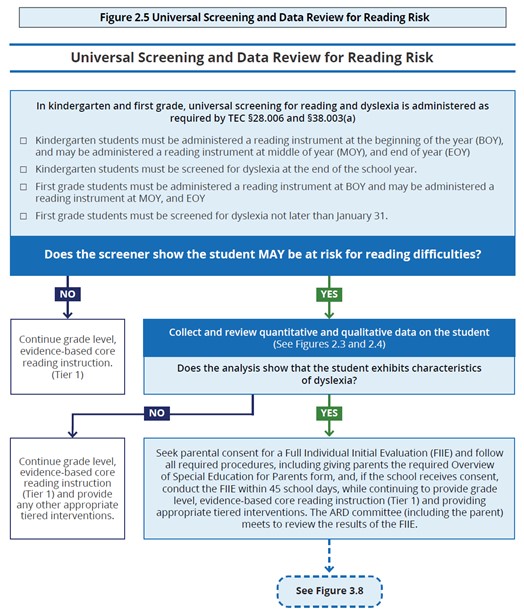
Figure 2.5
*See Figure 3.8 in the Dyslexia Handbook for Pathways for the Identification and Provision of Instruction for Students with Dyslexia. *(Note: This image was retrieved from the TEA Dyslexia Handbook.)
Dyslexia Referral Checklist
Language & Comprehension
Instructions: Please consider your observations of children’s behaviors within the classroom and school to complete this checklist. Read each item and evaluate whether a behavior is:
Checklist Key:
- Did Not Meet Grade Level Expectations – 2 Points
- Approaches Grade Level – 1 Point
- Meets Grade Level Expectations – 0 Points
- Masters Grade Level Expectations – 0 Points
- Student is able to use and understand a range of vocabulary words in conversation with adults (e.g., answering questions during read alouds).
- Masters Grade Level Expectations – Student appears to use and understand words that seem more advanced than peers when engaged in conversation with adults.
- Meets Grade Level Expectations – Student has the ability to use and understand grade level vocabulary when engaged in conversation with adults.
- Approaches Grade Level Expectations – Student appears to be able to use and understand a range of grade appropriate vocabulary but occasionally struggles using and understanding common vocabulary words when engaged in conversation with adults. Student might struggled knowing the names of objects, actions, and/or concepts.
- Did Not Meet Grade Level Expectations – Student routinely struggles using and understanding grade appropriate vocabulary when engaged in conversation with adults.
- Student is able to use language to have her/his needs met in the classroom (e.g., asking for help to complete a challenging task, asking to use the restroom).
- Masters Grade Level Expectations – Student is readily able to use language to have needs met within the classroom at advanced levels (e.g., May I use the restroom please? Could you help me open up my pack of markers?).
- Meets Grade Level Expectations – Student is competent using language to have needs met in the classroom. Utterances are fully formed but might lack some of the specificity of children who master grade level expectations (e.g., Can you open this?).
- Approaches Grade Level Expectations – Student attempts to have needs met in the classroom using language but it might be difficult to completely understand the student without relying on a combination of verbal and visual cues (e.g., child might vaguely say help while holding up an object).
- Did Not Meet Grade Level Expectations – Child frequently struggles using language to have needs met in the classroom. Child might point or use gestures to aid others in understanding.
- Student is able to understand and respond to peers who attempt to initiate conversation.
- Masters Grade Level Expectations – Student is easily able to understand and respond verbally to peers about a variety of topics and is able to use higher level language strategies (e.g., negotiation) language to navigate common classroom challenges. t
- Meets Grade Level Expectations – Student is able to understand and respond verbally to peers surrounding a variety of topics. However, the student might occasionally need adult support to navigate challenging classroom situations (e.g., teacher required to help resolve differences over access to materials).
- Approaches Grade Level Expectations – Student is sometimes able to understand and respond appropriately to peers. However, the child occasionally needs support from adults to navigate challenging situations.
- Did Not Meet Grade Level Expectations – Student often needs scaffolding support of adults to understand and respond appropriately to peers within the class.
Letter Knowledge & Sound-Symbol Recognition
- Student is able to identify all letter names. (Note: We recognize that the KPM Letter Naming subtest only measures a subset of letters. Therefore, other data should be considered when completing the rating for this item).
- Masters Grade Level Expectations – Student is able to fluently recall all upper and lower case letter names (i.e., able to identify letter names accurately without hesitation).
- Meets Grade Level Expectations – Student knows all letter names. However, the recall of letter names is not always fluent (i.e., takes time or hesitates when naming some letters).
- Approaches Grade Level Expectations – The student might occasionally incorrectly label commonly mistaken letter pairs (e.g., b, d, p, q).
- Did Not Meet Grade Level Expectations – In addition to incorrectly naming commonly mistaken letter pairs, the student struggles naming a number of the letters of the alphabet (e.g., approximately half of the letters are named incorrectly).
- Student is able to identify all letter sounds. (Note: We recognize that the KPM Letter Sounds subtest only measures a subset of letters. Therefore, other data should be considered when completing the rating for this item).
- Masters Grade Level Expectations – Student easily recalls all letter sounds fluency (i.e., able to identify letter sounds without hesitation).
- Meets Grade Level Expectations – Student knows all letter sounds. However, the recall of letter names is not automatic (i.e., takes time or hesitates when naming letters).
- Approaches Grade Level Expectations – The student might occasionally incorrectly name letter sounds, especially more difficult letter sounds (e.g., q and x).
- Did Not Meet Grade Level Expectations – In addition to not being able to identify more difficult letter sounds, the child struggles providing sounds for a number of the letters of the alphabet (e.g., approximately half of the letters sounds labeled incorrectly).
Phonological & Phonemic Awareness
- Student is able to separate sentences into words.
- Masters Grade Level Expectations – Student is easily able to separate sentences into words without error.
- Meets Grade Level Expectations – Student does a reasonably good job of separating sentences. However, the student might occasionally make mistakes when compound words are included in the sentence (e.g., footprint, without).
- Approaches Grade Level Expectations – Student is able to separate simple sentences of 3-4 words into single words (e.g., I want lunch). However, the student might struggle separating sentences that contain more words and/or include unfamiliar compound words.
- Did Not Meet Grade Level Expectations – Even though provided with ongoing instruction, student struggles separating simple sentences into individual words.
- Student is able to identify initial sounds (e.g., what is the first sound you hear in the word ‘sun’). *For Spanish-speaking students, the item example would be changed to (e.g., ¿Cuál es el primer sonido que eschuchas en la palabra gato?).
- Masters Grade Level Expectations – Student is easily able to identify initial sounds in words without hesitation and high accuracy.
- Meets Grade Level Expectations – Student is easily able to identify initial sounds in words. However, student might occasionally incorrectly label the initial sound in harder words (e.g., words starting with g or j).
- Approaches Grade Level Expectations – Student is able to identify initial sounds in some words but routinely makes mistakes.
- Did Not Meet Grade Level Expectations – Even though provided with ongoing instruction, student struggles identifying initial sounds in simple words.
- Student is able to blend individual sounds/phonemes when provided an oral example (e.g., what word do these sounds make /s/ /u/ /n/?). *For Spanish-speaking students, the item example would be changed to (e.g., ¿Qué palabra hacen estos sonidos /p/ /a/ /n/?).
- Masters Grade Level Expectations – Student is easily able to blend up to 5 or 6 individual sounds/phonemes.
- Meets Grade Level Expectations – Student is often able to blend up to 4-5 individual sounds/phonemes.
- Approaches Grade Level Expectations – Student is occasionally able to blend up to 3 phonemes. However, the student makes often makes mistakes when attempting more complicated blends.
- Did Not Meet Grade Level Expectations – Even though provided with ongoing instruction, student struggles blending 3 sounds or compound words.
Decoding Skills
- Student is able to use letter sound relationships to decode words that follow common spelling patterns: (e.g., VC, CVC, CCVC, and CVCC). *For Spanish-speaking students, the item example would be changed to (e.g., CV, VC, CCV, CVC, CVV, CVCV, CCVCV, and CVCCV).
- Masters Grade Level Expectations – Student is quite competent and almost always able to decode words that follow common spelling patterns (e.g., VC, CVC, CCVC, and CVCC). Decoding occurs fluently and without hesitation.
- Meets Grade Level Expectations – Student is usually able to decode words that follow common spelling patterns (e.g., VC, CVC, CCVC, and CVCC). However, the student might struggle decoding words with less familiar spelling patterns.
- Approaches Grade Level Expectations – Student is sometimes able to decode words with common spelling patterns (e.g., VC, CVC, CCVC, and CVCC). However, decoding is certainly not fluent and appears to take a great deal of effort.
- Did Not Meet Grade Level Expectations – Student is rarely, if ever, able to decode words with common spelling patterns (e.g., VC, CVC, CCVC, and CVCC).
Spelling
- Student is able to correctly spell common words with VC, CVC, and CCVC patterns. Note: Emphasis of this item is on spelling words correctly not handwriting). *For Spanish-speaking students, the item example would be changed to (e.g., CV, VC, CCV, CVC, VCV, CVCV, CCVCV, and CVCCV patterns).
- Masters Grade Level Expectations – Student is competent and almost always able to correctly spell words with common spelling patterns (e.g., VC, CVC, and CCVC).
- Meets Grade Level Expectations – Student is usually able to correctly spell words with common spelling patterns (e.g., VC, CVC, and CCVC).
- Approaches Grade Level Expectations – Student is occasionally able to spell words with common spelling patterns correctly (e.g., VC, CVC, and CCVC). However, student is just as likely to incorrectly spell words with common spelling patterns.
- Did Not Meet Grade Level Expectations – Student almost always incorrectly spells words with common spelling patterns (e.g., VC, CVC, and CVCC).
Observables
Instructions: Please consider your observations of children’s behaviors within the classroom and school to complete this checklist. Read each item and evaluate whether a behavior is:
Key:
- Almost Always-2 Points
- Often-1 Point
- Rarely-0 Points
- Never-0 Points
- When reading or attempting to read words in isolation or grade level texts, the student displays a lack of fluency (e.g., hesitant, often guesses, or frequently self- corrects).
- Almost Always – Student is never able to read words or text fluently. When reading, the student is always hesitant, halting, and struggles reading even simple words accurately.
- Often – Student is rarely able to read words, or text, fluently. When reading, the student will often misread or guess at words. Student often becomes tentative or hesitant when asked to read words and/or text.
- Rarely – Student is typically able to read with reasonable fluency but sometimes struggles or becomes flustered when reading less than familiar words/text. Student might occasionally become tentative or hesitant when asked to read challenging words/text.
- Never – Student never displays a lack of fluency and reading skills seem advanced for grade level.
- When engaged in reading activities alone or in a small-group setting, the student appears to display an inability to focus and/or engages in avoidance behaviors.
- Almost Always – Student almost always struggles focusing and remaining engaged when attempting to read words or grade level text. In addition, avoidant behaviors are observed when reading (e.g., looking away, giving up, or complaining).
- Often – Student often struggles focusing and remaining engaged when reading words or grade level text. In addition, avoidant behaviors are sometimes observed when reading (e.g., looking away, giving up, or complaining).
- Rarely – Student rarely has difficulty focusing and remaining actively engaged when reading. However, focus and engagement might wane slightly when attempting to read challenging text.
- Never – Student never struggles focusing and remaining actively engaged when reading. Focus and engagement is maintained even when attempting to read challenging text.
Incorporating Results of Screening Assessments
Instructions: Please consider your observations of children’s behaviors within the classroom and school to complete this checklist. Read each item and evaluate whether a behavior is:
Key:
- “High Risk Observed” scores receive a risk level score of 2. High Risk is defined as when a student has not responded to Tier 1 or Tier 2 intervention support. At this point, the classroom teacher/referral committee might be considering pursuing an evaluation under IDEA or Section 504
- “Some Risk Observed” scores receive a risk level score of 1. In this case, students have not responded as well as classmates to Tier 1 instruction and would likely benefit from Tier 2 intervention and ongoing monitoring.
- Ratings of “No Risk” or “Monitoring (Tier 1)” will receive a risk level score of 0.
- “Not Assessed” will receive a risk level score of 0.
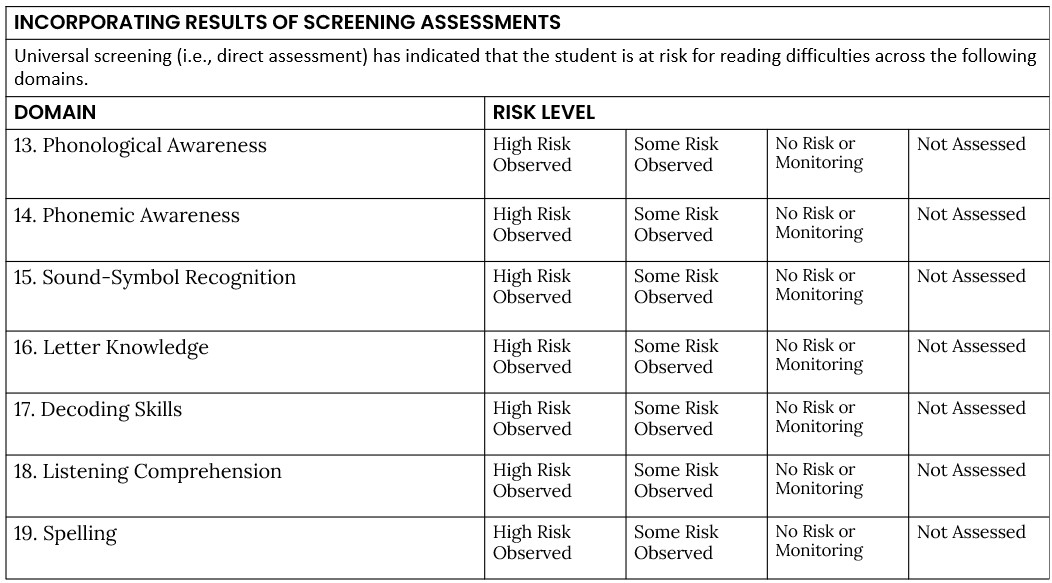
Notes:
*(Note: After completing the assessment, tally up the points from each column and add them together. If the student receives a score of 24 or greater, they should be considered for further evaluation to rule out reading difficulties. If you enter the scores online through CLI Engage, the score will automatically update and provide total results.)
References:
Texas Education Agency. “19 TAC Chapter 110. Texas Essential Knowledge and Skills for English Language Arts and Reading.” Texas Education Agency – 19 TAC Chapter 110. 2017. http://ritter.tea.state.tx.us/rules/tac/chapter110/index.html.
Texas Education Agency. THE DYSLEXIA HANDBOOK.
First Grade
Guide to Rating Anchors
The following anchors will be used to describe children’s early literacy/reading skills:
- Masters Grade Level: performance in this category indicates that the student is expected to succeed in the next grade with little or no academic intervention.
- Meets Grade Level: performance in this category indicates that students have a high likelihood of success in the next grade but might need some short-term, targeted academic intervention.
- Approaches Grade Level: performance in this category indicates that students are likely to succeed in the next grade with targeted academic intervention.
- Did Not Meet Grade Level: performance in this category indicates that students are unlikely to succeed in the next grade without significant, ongoing academic intervention.
Explanation of Scoring
In most of the Dyslexia Referral Checklist items, there are four possible ratings (i.e., Did not meet grade level expectations, Approaches grade level expectations, Meets grade level expectations, Masters grade level expectations).
- Ratings of “Did not meet grade level expectations” receive a risk level score of 2.
- Ratings of “Approaches grade level expectations” receive a risk level score of 1.
- Ratings of “Meets or Masters grade level expectations” each receive a risk level score of 0.
A similar strategy is used in the 2 questions in the Observable section. These 2 questions utilize different anchors (i.e., Never, Rarely, Often, Almost Always).
- Ratings of “Almost Always” receive a risk level score of 2.
- Ratings of “Often” receive a risk level score of 1.
- Ratings of “Rarely” or “Never” receive a risk level score of 0.
Items that document the results of screening assessment are scored differently than the previous items.
- “High Risk Observed” scores receive a risk level score of 2. High Risk is defined as when a student has not responded to Tier 1 or Tier 2 intervention support. At this point, the classroom teacher/referral committee might be considering pursuing an evaluation under IDEA or Section 504.
- “Some Risk Observed” scores receive a risk level score of 1. In this case, students have not responded as well as classmates to Tier 1 instruction and would likely benefit from Tier 2 intervention and ongoing monitoring.
- Ratings of “No Risk” or “Monitoring (Tier 1)” and “Not Assessed” will receive a risk level score of 0.
(Note: The “Not Assessed” rating was included because it is recognized that not all universal screening/progress monitoring measures evaluate all domains. Not Assessed ratings might also represent that a classroom teacher did not complete universal progress monitoring measures for some reason (e.g., sensory impairment, behavioral difficulties, etc.). In short, the Dyslexia Referral Committee, teacher, and school administrators (e.g., Special Ed Coordinator) on each campus will be responsible for evaluating all data to determine if a more comprehensive evaluation is required. The Dyslexia Referral Checklist should be seen as one piece of information to help determine if a more comprehensive evaluation is necessary.)
CUT OFF SUGGESTIONS
The CLI and TEA recognize that with any new instrument, there will be a learning curve in relation to cut-off criteria. In reality, the Dyslexia Referral Checklist will become a stronger instrument over time as data is collected and analyzed by TEA, the CLI, and local school districts. As TEA and the CLI are committed to continuing this work, it is hoped that districts will use the suggested cutoff scores described below to have meaningful conversations about whether or not students who receive high-risk scores would benefit from more comprehensive assessment of their reading skills. In March of 2020, the Dyslexia Referral Checklist was distributed to approximately 40 stakeholders (e.g., Dyslexia Specialists, TEA officials, and content experts). Twenty individuals answered a question about cut score determination. When averaged together, most raters recommended that students who receive a score of 32 or greater should be considered for further evaluation to rule out reading differences. Children who would be considered to be at the greatest risk (i.e., most severe rating on each item) would receive a Risk Score of 50 points.
NOTES ON ELL CHILDREN
It is recognized that many of the skills important for reading in Spanish or English are quite similar. For instance, research recognizes that children learning to read in either language benefit when they have well-developed language, phonological awareness, and letter knowledge/letter sound skills. Therefore, many of the items contained in the DRC work equally well for children learning to read Spanish or English. However, there are some subtle differences in which vowel-consonant combinations children learn first when being taught to read and spell. Five items (i.e., 6, 7, 9, 10, and 13) of the DRC-1st include different Spanish examples for items evaluating phonological awareness, decoding and spelling skills. The rest of the content is identical for Spanish and English versions of the DRC-1st. The cut-off score for Spanish and English versions is identical (i.e., a score of 32 or more should be considered to be at-risk).
NEXT STEPS
TEA Dyslexia Handbook provides teachers and school districts with a wealth of information surrounding how to best respond to students where a suspicion of dyslexia exists. Figure 2.5 of the current Texas Dyslexia Handbook provides a graphic representation of how the screening and referral process should occur. The Dyslexia Referral Checklist, along with universal screening for reading and dyslexia should be used to help guide school committees to determine how to intervene to help students. As previously mentioned, data that should be considered might include results of current and previous screening measures, formal and informal classroom reading assessments, additional brief and targeted skill assessments, observable behaviors during screening, other observations of student progress, parent/guardian input, work samples, and intervention history.
Results of the DRC should be used to supplement information gathered to determine if a more comprehensive evaluation for dyslexia or Special Education services would be warranted. Results from the DRC should be considered to fit in the “Collect and review quantitative and qualitative data on the student” (i.e., highlighted by a red rectangular box below). Essentially, school districts have the option of utilizing subtests on the Engage platform (e.g., TPRI/Tejas LEE) or subtests from other assessment systems in use to guide DRC First Grade ratings. Thus, the DRC is an important piece of data that allows teachers to document their concerns about reading difficulties in a systematic way.
The Dyslexia Referral Team within a school/district then brings all of the information together. Professionals move through the decision tree located in the TEA Dyslexia Handbook. If a referral committee believes data indicates a child DOES exhibit characteristics of dyslexia, then initiation of the IDEA or Section 504 evaluation should begin. If analysis of all of the information considered shows that the student exhibits reading difficulties that are NOT consistent with characteristics of Dyslexia or a related disorder, then districts should continue grade level, evidence-based core reading instruction (Tier 1) and provide any other appropriate tiered interventions. Consider whether the student should be referred for Section 504 evaluation.
Figure 2.5
*See Figure 3.8 in the Dyslexia Handbook for Pathways for the Identification and Provision of Instruction for Students with Dyslexia. *(Note: This image was retrieved from the TEA Dyslexia Handbook.)
Dyslexia Referral Checklist
Language & Comprehension
Instructions: Please consider your observations of children’s behaviors within the classroom and school to complete this checklist. Read each item and evaluate whether a behavior is:
Checklist Key:
- Did Not Meet Grade Level Expectations – 2 Points
- Approaches Grade Level – 1 Point
- Meets Grade Level Expectations – 0 Points
- Masters Grade Level Expectations – 0 Points
- During conversation with adults, the student is able to use and understand a range of vocabulary words that identify actions, directions, positions, sequences, categories, and locations.
- Masters Grade Level Expectations – During conversation, the student appears to use and understand vocabulary words that identify actions, directions, positions, sequences, categories, and locations in a manner that appears to be more advanced than peers.
- Meets Grade Level Expectations – During conversation, the student appears to use and understand grade level vocabulary words that identify actions, directions, positions, sequences, categories, and locations in a manner that is similar to peers.
- Approaches Grade Level Expectations – During conversation, the student appears to use and understand a range of grade level vocabulary but might occasionally struggle using higher level vocabulary (e.g., actions, directions, positions, sequences, categories, and locations). Student occasionally struggles knowing less common objects and concepts.
- Did Not Meet Grade Level Expectations – Student routinely struggles using higher level vocabulary to identify actions, directions, positions, sequences, categories, and locations. While the student might use appropriate vocabulary to name common objects, the student is more likely to struggle knowing less common objects or concepts.
- During classroom conversations and/or book reads, the student listens actively, asks relevant questions to clarify information, and can answer questions using multiple word phrases.
- Masters Grade Level Expectations – During classroom conversations, the student is able to listen actively, ask relevant questions, and can answer questions using multiple-word phrases in a manner that is more advanced than most peers.
- Meets Grade Level Expectations – During classroom conversations, the student is usually able to listen actively, ask relevant questions, and can answer questions using multiple-word phrases in a manner that is similar to peers.
- Approaches Grade Level Expectations – During classroom conversations, the student occasionally struggles listening activity, might occasionally ask irrelevant questions, and sometimes has trouble answering questions using multiple-word phrases.
- Did Not Meet Grade Level Expectations – During classroom conversations, the student frequently struggles listening activity, frequently asks irrelevant questions, and often has difficulty answering questions using multiple-word phrases.
- Student is able to work collaboratively with others following rules of classroom discussion, including listening to others, speaking when recognized, and making appropriate contributions to classroom conversation.
- Masters Grade Level Expectations – Student is easily able to work collaboratively with others and follows rules of classroom discussion (e.g., listening to others, speaking when recognized, and making appropriate contributions to the conversation). The student’s ability to engage in appropriate classroom discussion is more advanced than peers.
- Meets Grade Level Expectations – Student is usually able to work collaboratively with others and follows rules of classroom discussion (e.g., listening to others, speaking when recognized, and making appropriate contributions to the conversation). However, the student might occasionally need adult encouragement to follow rules of classroom discussion.
- Approaches Grade Level Expectations – Student is sometimes able to work collaboratively with others and follow rules of classroom discussion (e.g., listening to others, speaking when recognized, and making appropriate contributions to the conversation). However, the student often needs encouragement and reminders to follow rules of classroom conversation.
- Did Not Meet Grade Level Expectations – Student often struggles to work collaboratively with others and follow rules of classroom discussion. The student might speak without being recognized, make comments about topics not under discussion, and needs frequent reminders to listen to peers.
Letter Knowledge & Sound-Symbol Recognition
- Student is able to identify all letter names and letter sounds.
- Masters Grade Level Expectations – Student is able to fluently recall all upper and lower case letter names and letter sounds (i.e., able to identify letter names and sounds accurately without hesitation).
- Meets Grade Level Expectations – Student knows almost all letter names letter sounds (e.g., incorrectly naming 1-2 letter names or sounds). In addition to occasionally misidentifying a few letter names or sounds (e.g., 3), the student might take time thinking or hesitate when naming a few letter names or sounds).
- Approaches Grade Level Expectations – The student occasionally incorrectly labels several (e.g., 4 or more) letter names and/or letter sounds. In addition, letter name/sound fluency is lacking.
- Did Not Meet Grade Level Expectations – The student misidentifies a number of letter names and/or sounds (e.g., 5 or more). In addition, letter name/sound fluency is lacking.
Phonological & Phonemic Awareness
- Student is able to produce a series of rhyming words.
- Masters Grade Level Expectations – Student is easily able to produce a series of rhyming words when asked (e.g., frog, log, dog, bog, hog, fog, nog).
- Meets Grade Level Expectations – Student is able to produce some rhyming words when asked (e.g., frog, log, dog). However, the recall of rhyming words is not automatic (e.g., takes additional time and/or hesitates when asked).
- Approaches Grade Level Expectations – The student might be able to provide one or two rhyming word when asked. In addition, the student is likely to make several mistakes when completing the task.
- Did Not Meet Grade Level Expectations – The student is unable to consistently produce rhyming words when asked.
- Student is readily able to blend spoken phonemes to form one-syllable words, including initial and/or final consonant blends (e.g., what words do these sounds make/st/-/o/-/p/?).
For Spanish-speaking students the item example would be changed to Student is readily able to blend spoken phonemes to form one-syllable words, including consonant blends (e.g., ¿qué palabra hacen estos sonidos /fl/-/a/-/n/?).
- Masters Grade Level Expectations – Student is readily able to blend spoken phonemes to form one-syllable words including initial and/or final consonant blends. The student’s performance on this task is better than peers.
- Meets Grade Level Expectations – Student is able to blend spoken phonemes to form one-syllable words including initial and/or final consonant blends. However, the student might occasionally make mistakes when attempting to blend less common/harder phonemes.
- Approaches Grade Level Expectations – Student is infrequently able to blend spoken phonemes to form one-syllable words including initial and/or final consonant blends. The task is obviously difficult for the student.
- Did Not Meet Grade Level Expectations – The student is unable to blend spoken phonemes to form one-syllable words including initial and/or final consonant blends. The student might not respond or guess randomly when asked to blend spoken phonemes.
- Student is able to recognize a change in a spoken word when a phoneme is added (e.g., what word do you get when you add /t/ to the end of bell) and/or removed (what is slip without /s).
For Spanish-speaking students the item example would be changed to Student is able to recognize a change in a spoken word when a phoneme is added (e.g., ¿Qué palabra obtienes cuando agregas /p/ al comienzo de ala?) y/o eliminas (¿qué es blanco sin /l/?).
- Masters Grade Level Expectations – Student is easily able to recognize a change in a spoken word when a phoneme is added or removed. The student is able to accurately complete these types of tasks in a manner that is more advanced than peers.
- Meets Grade Level Expectations – Student is generally able to recognize a change in a spoken word when a phoneme is added or removed. However, the student might occasionally answer incorrectly or guess when the sounds being manipulated are more difficult.
- Approaches Grade Level Expectations – The student occasionally is able to recognize a change in a spoken word when a phoneme is added or removed. However, the child is likely to make mistakes or guess when sounds being manipulated are more difficult.
- Did Not Meet Grade Level Expectations – The student struggles recognizing a change in a spoken word when a phoneme is added or removed. The child frequently makes mistakes and randomly guesses even when working with easier items.
- Student is able to segment one-syllable words of 3-5 phonemes including words with initial and/or final blends.
- Masters Grade Level Expectations – Student is easily able to segment one-syllable words of 3-5 phonemes including words with initial and/or final blends. The student’s skill in this area seems advanced compared to peers.
- Meets Grade Level Expectations – Student is often able to segment one-syllable words of 3-5 phonemes including words with initial and/or final blends. The student might occasionally struggle segmenting longer/more complicated words.
- Approaches Grade Level Expectations – Student is occasionally able to segment one-syllable words of 3-5 syllables including words with initial and/or final blends. The student typically struggles segmenting longer/more complicated words.
- Did Not Meet Grade Level Expectations – Even though provided with ongoing instruction, the student struggles segmenting one-syllable words of 3-5 phonemes.
Decoding, Reading, Reading Comprehension
- Student is able decode words accurately in isolation and in context by understanding common vowel-consonant combinations: (e.g., VC, CVC, CCVC, CVCC, and CVCCC).
For Spanish-speaking students the item example would be changed to Student is able decode words accurately in isolation and in context by understanding common syllable patterns: (e.g., CV, CVCC).
- Masters Grade Level Expectations – Student is quite competent and almost always able to decode words fluently in isolation and in context by understanding common vowel-consonant combinations (e.g., e.g., VC, CVC, CCVC, CVCC, and CVCCC). Decoding skills appear to be more advanced than peers.
- Meets Grade Level Expectations – Student is usually able to decode words fluently in isolation and in context by understanding common vowel-consonant combinations (e.g., e.g., VC, CVC, CCVC, CVCC, and CVCCC). Student might occasionally have difficulty decoding some of the less common vowel-consonant combinations.
- Approaches Grade Level Expectations – Student is sometimes able to decode words fluently in isolation and in context by understanding common vowel-consonant combinations (e.g., e.g., VC, CVC, CCVC, CVCC, and CVCCC). Student typically has difficulty decoding some of the more complex vowel-consonant combinations. In addition, the student’s decoding skills appear to be somewhat less well-developed than peers.
- Did Not Meet Grade Level Expectations – Student is rarely, if ever, able to decode words fluently in isolation and in context by understanding common vowel-consonant combinations (e.g., e.g., VC, CVC, CCVC, CVCC, and CVCCC). Decoding skills appear to be far behind peers.
- Student is able to use knowledge of base words to decode common compound words, contractions, and words with inflectional endings (e.g., -ed, – s, and –es).
For Spanish-speaking students the item example would be changed to Student is able to use knowledge of base words to decode common compound words and words with inflectional endings (e.g., -s, -es, -an/-en).
- Masters Grade Level Expectations – Student is almost always able to use knowledge of base words to decode common compound words, contractions, and words with inflectional endings (e.g., -ed, -s, and –es). Decoding skills appear to be much better developed than most peers.
- Meets Grade Level Expectations – Student is usually able to use knowledge of base words to decode common compound words, contractions, and words with inflectional endings (e.g., -ed, -s, and –es). Decoding skills appear to be in line with peers and grade expectations.
- Approaches Grade Level Expectations – Student is rarely able to use knowledge of base words to decode common compound words, contractions, and words with inflectional endings (e.g., -ed, -s, and –es). Decoding skills are clearly less well developed than peers.
- Did Not Meet Grade Level Expectations – Student is unable to use knowledge of base words to decode common compound words, contractions, and words with inflectional endings (e.g., -ed, -s, and –es). Decoding skills are well behind peers and grade expectations.
- Student is able to read at least 100 high-frequency words from a research-based list.
- Masters Grade Level Expectations – Student is able to read at least 100 high-frequency words from a research-based list fluently without self- corrections.
- Meets Grade Level Expectations – Student is able to read at least 90 of 100 high-frequency words from a research-based list without mistakes. However, the student might lack fluency and need to sound out some words letter by letter.
- Approaches Grade Level Expectations – Student is able to read less than half of a list of 100 high-frequency words from a research-based list. In addition, reading fluency appears to lag behind peers. Student occasionally misreads or guesses at words.
- Did Not Meet Grade Level Expectations – Student correctly reads less than 20 of 100 high-frequency words from a research-based list. In addition, when reading the student is always hesitant, halting, and struggles reading even simple words accurately.
- Student is able to generate and answer questions and generate questions before, during, and after reading.
- Masters Grade Level Expectations – When reading independently (or in a group setting), the student is quite adept at generating and answering questions related to the text before, during, and after reading
- Meets Grade Level Expectations – When reading independently (or in a group setting), the student is usually adept at generating and answering questions related to the text before, during, and after reading.
- Approaches Grade Level Expectations – When reading independently (or in a group setting), the student is occasionally adept at generating and answering questions related to the text before, during, and after reading. The student sometimes asks, or answers, questions in a manner that demonstrates a lack of understanding of the text.
- Did Not Meet Grade Level Expectations – When reading independently (or in a group setting), the student struggles generating and answering questions related to the text before, during, and after reading. The student might fail to ask, or answer, questions due to a lack of understanding of the text.
Spelling & Writing
- Student is able to correctly spell words with initial and final consonant blends, digraphs, and trigraphs (e.g., VC, CVC, CCVC, and CCCVC patterns).
For Spanish-speaking students the item example would be changed to Student is able to correctly spell syllables with consonant blends and digraphs (e.g., CCV and CCVC).
- Masters Grade Level Expectations – Student is competent and almost always able to correctly spell words with common spelling patterns (e.g., VC, CVC, and CCVC).
- Meets Grade Level Expectations – Student is usually able to correctly spell words with common spelling patterns (e.g., VC, CVC, CCVC, and CCCVC).
- Approaches Grade Level Expectations – Student is occasionally able to correctly spell words with common spelling patterns (e.g., VC, CVC, CCVC, and CCCVC). However, student is just as likely to incorrectly spell words with common spelling patterns.
- Did Not Meet Grade Level Expectations – Student almost always incorrectly spells words with common spelling patterns (e.g., VC, CVC, CCVC, and CCCVC).
- Student is able to correctly spell high-frequency words from a research-based list.
- Masters Grade Level Expectations – Student is competent and often able to correctly spell high-frequency words from a research-based list. Student’s spelling skills are apparent even when spelling unfamiliar words (i.e., words that haven’t been emphasized in class).
- Meets Grade Level Expectations – Student is usually able to correctly spell high-frequency words from a research-based list. The student might sometimes struggle spelling less familiar words (i.e., words that haven’t been emphasized in class).
- Approaches Grade Level Expectations – Student is sometimes able to correctly spell high-frequency words from a research-based list. The student typically struggles spelling less familiar words (i.e., words that haven’t been emphasized in class).
- Did Not Meet Grade Level Expectations – Student almost always incorrectly spells high-frequency words from a research-based list. The student rarely spells words correctly and misspelled words are not close phonetic approximations.
Observables
Instructions: Please consider your observations of children’s behaviors within the classroom and school to complete this checklist. Read each item and evaluate whether a behavior is:
Key:
- Almost Always-2 Points
- Often-1 Point
- Rarely-0 Points
- Never-0 Points
- When reading or attempting to read words in isolation or grade level texts, the student displays a lack of fluency (e.g., hesitant, often guesses, or frequently self- corrects).
- Almost Always – Student is never able to read words or text fluently. When reading, the student is always hesitant, halting, and struggles reading even simple words accurately.
- Often – Student is rarely able to read words, or text, fluently. When reading, the student will often misread or guess at words. Student often becomes tentative or hesitant when asked to read words and/or text.
- Rarely – Student is typically able to read with reasonable fluency but sometimes struggles or becomes flustered when reading less than familiar words/text. Student might occasionally become tentative or hesitant when asked to read challenging words/text.
- Never – Student never displays a lack of fluency and reading skills seem advanced for grade level.
- When engaged in reading activities alone or in a small-group setting, the student appears to display an inability to focus and/or engages in avoidance behaviors.
- Almost Always – Student almost always struggles focusing and remaining engaged when attempting to read words or grade level text. In addition, avoidant behaviors are observed when reading (e.g., looking away, giving up, or complaining).
- Often – Student often struggles focusing and remaining engaged when reading words or grade level text. In addition, avoidant behaviors are sometimes observed when reading (e.g., looking away, giving up, or complaining).
- Rarely – Student rarely has difficulty focusing and remaining actively engaged when reading. However, focus and engagement might wane slightly when attempting to read challenging text.
- Never – Student never struggles focusing and remaining actively engaged when reading. Focus and engagement is maintained even when attempting to read challenging text.
Incorporating Results of Screening Assessments
Instructions: Please consider your observations of children’s behaviors within the classroom and school to complete this checklist. Read each item and evaluate whether a behavior is:
Key:
- “High Risk Observed” scores receive a risk level score of 2. High Risk is defined as when a student has not responded to Tier 1 or Tier 2 intervention support. At this point, the classroom teacher/referral committee might be considering pursuing an evaluation under IDEA or Section 504
- “Some Risk Observed” scores receive a risk level score of 1. In this case, students have not responded as well as classmates to Tier 1 instruction and would likely benefit from Tier 2 intervention and ongoing monitoring.
- “Ratings of “No Risk” or “Monitoring (Tier 1)” will receive a risk level score of 0.
- “Not Assessed” will receive a risk level score of 0.

First Grade
Notes:
*(Note: After completing the assessment, tally up the points from each column and add them together. If the student receives a score of 32 or greater, they should be considered for further evaluation to rule out reading difficulties. If you enter the scores online through CLI Engage, the score will automatically update and provide total results.)
References:
Texas Education Agency. “19 TAC Chapter 110. Texas Essential Knowledge and Skills for English Language Arts and Reading.” Texas Education Agency – 19 TAC Chapter 110. 2017. http://ritter.tea.state.tx.us/rules/tac/chapter110/index.html.
Texas Education Agency. THE DYSLEXIA HANDBOOK.
Second Grade
Guide to Rating Anchors
The following anchors will be used to describe children’s early literacy/reading skills:
- Masters Grade Level: performance in this category indicates that the student is expected to succeed in the next grade with little or no academic intervention.
- Meets Grade Level: performance in this category indicates that students have a high likelihood of success in the next grade but might need some short-term, targeted academic intervention.
- Approaches Grade Level: performance in this category indicates that students are likely to succeed in the next grade with targeted academic intervention.
- Did Not Meet Grade Level: performance in this category indicates that students are unlikely to succeed in the next grade without significant, ongoing academic intervention.
Explanation of Scoring
In most of the Dyslexia Referral Checklist items, there are four possible ratings (i.e., Did not meet grade level expectations, Approaches grade level expectations, Meets grade level expectations, Masters grade level expectations).
- Ratings of “Did not meet grade level expectations” receive a risk level score of 2.
- Ratings of “Approaches grade level expectations” receive a risk level score of 1.
- Ratings of “Meets or Masters grade level expectations” each receive a risk level score of 0.
A similar strategy is used in the 2 questions in the Observable section. These 2 questions utilize different anchors (i.e., Never, Rarely, Often, Almost Always).
- Ratings of “Almost Always” receive a risk level score of 2.
- Ratings of “Often” receive a risk level score of 1.
- Ratings of “Rarely” or “Never” receive a risk level score of 0.
Items that document the results of screening assessment are scored differently than the previous items.
- “High Risk Observed” scores receive a risk level score of 2. High Risk is defined as when a student has not responded to Tier 1 or Tier 2 intervention support. At this point, the classroom teacher/referral committee might be considering pursuing an evaluation under IDEA or Section 504
- “Some Risk Observed” scores receive a risk level score of 1. In this case, students have not responded as well as classmates to Tier 1 instruction and would likely benefit from Tier 2 intervention and ongoing monitoring.
- Ratings of “No Risk” or “Monitoring (Tier 1)” and “Not Assessed” will receive a risk level score of 0.
(Note: The “Not Assessed” rating was included because it is recognized that not all universal screening/progress monitoring measures evaluate all domains. Not Assessed ratings might also represent that a classroom teacher did not complete universal progress monitoring measures for some reason (e.g., sensory impairment, behavioral difficulties, etc.). In short, the Dyslexia Referral Committee, teacher, and school administrators (e.g., Special Ed Coordinator) on each campus will be responsible for evaluating all data to determine if a more comprehensive evaluation is required. The Dyslexia Referral Checklist should be seen as one piece of information to help determine if a more comprehensive evaluation is necessary.)
CUT OFF SUGGESTIONS
The CLI and TEA recognize that with any new instrument there will be a learning curve in relation to cut-off criteria. In reality, the Dyslexia Referral Checklist will become a stronger instrument over time as data is collected and analyzed by TEA, the CLI, and local school districts. As TEA and the CLI are committed to continuing this work, it is hoped that districts will use the suggested cutoff scores described below to have meaningful conversations about whether or not students who receive high-risk scores would benefit from more comprehensive assessment of their reading skills. In March of 2020, the Dyslexia Referral Checklist was distributed to approximately 40 stakeholders (e.g., Dyslexia Specialists, TEA officials, and content experts). Twenty individuals answered a question about cut score determination. When averaged together, most raters recommended that students who receive a score of 34 or greater should be considered for further evaluation to rule out reading differences. Children who would be considered to be at the greatest risk (i.e., most severe rating on each item) would receive a Risk Score of 52 points.
NOTES ON ELL CHILDREN
It is recognized that many of the skills important for reading in Spanish or English are quite similar. For instance, research recognizes that children learning to read in either language benefit when they have well-developed language, phonological awareness, and letter knowledge/letter sound skills. Therefore, many of the items contained in the DRC work equally well for children learning to read Spanish or English. However, there are some subtle differences in which vowel-consonant combinations children learn first when being taught to read and spell. Several items in the DRC-2nd grade (i.e., 5, 6, 8, 9, 10, and 13) include different Spanish examples for items evaluating phonological awareness, decoding and spelling skills. The rest of the content is identical for Spanish and English versions of the DRC-2nd. Given that the 20-21 academic year is essentially a pilot project, the cut-off score for Spanish and English versions is identical (i.e., score of 34 or more should be considered to be at-risk).
NEXT STEPS
The TEA Dyslexia Handbook provides teachers and school districts with a wealth of information surrounding how to best respond to students where a suspicion of dyslexia exists. Figure 2.5 of the current Texas Dyslexia Handbook provides a graphic representation of how the screening and referral process should occur. The Dyslexia Referral Checklist, along with universal screening for reading and dyslexia should be used to help guide school committees to determine how to intervene to help students. As previously mentioned, data that should be considered might include results of current and previous screening measures, formal and informal classroom reading assessments, additional brief and targeted skill assessments, observable behaviors during screening, other observations of student progress, parent/guardian input, work samples, and intervention history.
Results of the DRC should be used to supplement information gathered to determine if a more comprehensive evaluation for dyslexia or Special Education services would be warranted. Results from the DRC should be considered to fit in the “Collect and review quantitative and qualitative data on the student” (i.e., highlighted by a red rectangular box below). Essentially, school districts have the option of utilizing subtests on the Engage platform (e.g., TPRI/Tejas LEE) or subtests from other assessment systems in use to guide DRC First Grade ratings. Thus, the DRC is an important piece of data that allows teachers to document their concerns about reading difficulties in a systematic way.
The Dyslexia Referral Team within a school/district then brings all of the information together. Professionals move through the decision tree located in the TEA Dyslexia Handbook. If a referral committee believes data indicates a child DOES exhibit characteristics of dyslexia, then initiation of the IDEA or Section 504 evaluation should begin. If analysis of all of the information considered shows that the student exhibits reading difficulties that are NOT consistent with characteristics of Dyslexia or a related disorder, then districts should continue grade level, evidence-based core reading instruction (Tier 1) and provide any other appropriate tiered interventions. Consider whether the student should be referred for Section 504 evaluation.
Figure 2.5
*See Figure 3.8 in the Dyslexia Handbook for Pathways for the Identification and Provision of Instruction for Students with Dyslexia. *(Note: This image was retrieved from the TEA Dyslexia Handbook.)
Dyslexia Referral Checklist
Language & Comprehension
Instructions: Please consider your observations of children’s behaviors within the classroom and school to complete this checklist. Read each item and evaluate whether a behavior is:
Checklist Key:
- Did Not Meet Grade Level Expectations – 2 Points
- Approaches Grade Level – 1 Point
- Meets Grade Level Expectations – 0 Points
- Masters Grade Level Expectations – 0 Points
- During classroom conversations and/or book reads, the student is able to share information and ideas that focus on the topic under discussion.
- Masters Grade Level Expectations – During classroom conversations and/or book reads, the student is able to share information and ideas that focus on the topic under discussion in a manner that is more advanced than most peers.
- Meets Grade Level Expectations – During classroom conversations and/or book reads, the student is able to share information and ideas that focus on the topic under discussion in a manner that is similar to peers.
- Approaches Grade Level Expectations – During classroom conversations and/or book reads, the student occasionally struggles sharing information and ideas that focus on the topic under discussion. For example, the student might have difficulty recalling story elements in the order that they occurred.
- Did Not Meet Grade Level Expectations – During classroom conversation and/or book reads, the student frequently has difficulty sharing information and ideas that focus on the topic under discussion. For example, when retelling the plot of a story the student might leave out important information and add in information not relevant to the story.
- During classroom conversations and/or book reads, the student listens actively, asks relevant questions to clarify information, and can answer questions using multiple word phrases.
- Masters Grade Level Expectations – During classroom conversations, the student is able to listen actively, ask relevant questions, and can answer questions using multiple-word phrases in a manner that is more advanced than most peers.
- Meets Grade Level Expectations – During classroom conversations, the student is usually able to listen actively, ask relevant questions, and can answer questions using multiple-word phrases in a manner that is similar to peers.
- Approaches Grade Level Expectations – During classroom conversations, the student occasionally struggles listening activity, might occasionally ask irrelevant questions, and sometimes has trouble answering questions using multiple-word phrases.
- Did Not Meet Grade Level Expectations – During classroom conversations, the student frequently struggles listening activity, frequently asks irrelevant questions, and often has difficulty answering questions using multiple-word phrases.
- Student is able to work collaboratively with others following rules of classroom discussion, including listening to others, speaking when recognized, and making appropriate contributions to classroom conversation.
- Masters Grade Level Expectations – Student is easily able to work collaboratively with others and follows rules of classroom discussion (e.g., listening to others, speaking when recognized, and making appropriate contributions to the conversation). The student’s ability to engage in appropriate classroom discussion is more advanced than peers.
- Meets Grade Level Expectations – Student is usually able to work collaboratively with others and follows rules of classroom discussion (e.g., listening to others, speaking when recognized, and making appropriate contributions to the conversation). However, the student might occasionally need adult encouragement to follow rules of classroom discussion.
- Approaches Grade Level Expectations – Student is sometimes able to work collaboratively with others and follow rules of classroom discussion (e.g., listening to others, speaking when recognized, and making appropriate contributions to the conversation). However, the student often needs encouragement and reminders to follow rules of classroom conversation.
- Did Not Meet Grade Level Expectations – Student often struggles to work collaboratively with others and follow rules of classroom discussion. The student might speak without being recognized, make comments about topics not under discussion, and needs frequent reminders to listen to peers.
Phonological & Phonemic Awareness
- Student is able to produce a series of rhyming words.
- Masters Grade Level Expectations – Student is easily able to produce a series of rhyming words when asked (e.g., frog, log, dog, bog, hog, fog, nog).
- Meets Grade Level Expectations – Student is able to produce some rhyming words when asked (e.g., frog, log, dog). However, the recall of rhyming words is not automatic (e.g., takes additional time and/or hesitates when asked).
- Approaches Grade Level Expectations – The student might be able to provide one or two rhyming words when asked. In addition, the student is likely to make several mistakes when completing the task.
- Did Not Meet Grade Level Expectations – The student is unable to consistently produce rhyming words when asked.
- Student is readily able to blend spoken phonemes to form one-syllable words, including initial and/or final consonant blends (e.g., what words do these sounds make/st/-/o/-/p/?).
For Spanish-speaking students, the item example would be changed to Student is readily able to blend spoken phonemes to form one-syllable words, including consonant blends (e.g., ¿qué palabra hacen estos sonidos /fl/-/a/-/n/?).
- Masters Grade Level Expectations – Student is readily able to blend spoken phonemes to form one-syllable words including initial and/or final consonant blends. The student’s performance on this task is better than peers.
Meets Grade Level Expectations – Student is able to blend spoken phonemes to form one-syllable words, including initial and/or final consonant blends. However, the student might occasionally make mistakes when attempting to blend less common/harder phonemes.
Approaches Grade Level Expectations – Student is infrequently able to blend spoken phonemes to form one-syllable words, including initial and/or final consonant blends. The task is obviously difficult for the student.
Did Not Meet Grade Level Expectations – The student is unable to blend spoken phonemes to form one-syllable words, including initial and/or final consonant blends. The student might not respond or guess randomly when asked to blend spoken phonemes.
- Student is able to recognize a change in a spoken word when a phoneme is added (e.g., what word do you get when you add /t/ to the end of bell) and/or removed (what is slip without /s).
For Spanish-speaking students, the item example would be changed to Student is able to recognize a change in a spoken word when a phoneme is added (e.g., ¿Qué palabra obtienes cuando agregas /p/ al comienzo de ala?) y/o eliminas (¿qué es blanco sin /l/?).
- Masters Grade Level Expectations – Student is easily able to recognize a change in a spoken word when a phoneme is added or removed. The student is able to accurately complete these types of tasks in a manner that is more advanced than peers.
- Meets Grade Level Expectations – Student is generally able to recognize a change in a spoken word when a phoneme is added or removed. However, the student might occasionally answer incorrectly or guess when the sounds being manipulated are more difficult.
- Approaches Grade Level Expectations – The student occasionally is able to recognize a change in a spoken word when a phoneme is added or removed. However, the child is likely to make mistakes or guess when sounds being manipulated are more difficult.
- Did Not Meet Grade Level Expectations – The student struggles recognizing a change in a spoken word when a phoneme is added or removed. The child frequently makes mistakes and randomly guesses even when working with easier items.
- Student is able to segment one-syllable words of 3-5 phonemes, including words with initial and/or final blends.
- Masters Grade Level Expectations – Student is easily able to segment one-syllable words of 3-5 phonemes, including words with initial and/or final blends. The student’s skill in this area seems advanced compared to peers.
- Meets Grade Level Expectations – Student is often able to segment one-syllable words of 3-5 phonemes, including words with initial and/or final blends. The student might occasionally struggle segmenting longer/more complicated words.
- Approaches Grade Level Expectations – Student is occasionally able to segment one-syllable words of 3-5 syllables including words with initial and/or final blends. The student typically struggles segmenting longer/more complicated words.
- Did Not Meet Grade Level Expectations – Even though provided with ongoing instruction, the student struggles segmenting one-syllable words of 3-5 phonemes.
Decoding, Reading, and Reading Comprehension
- Student is able decode words accurately in isolation and in context by understanding common vowel-consonant combinations: (e.g., VC, CVC, CVCC, and CVCCC).
For Spanish-speaking students, the item example would be changed to Student is able decode words accurately in isolation and in context by understanding common syllable patterns: (e.g., CV, VC, CCV, CVC, VCV, CVCV, CCVCV, and CVCCV).
- Masters Grade Level Expectations – Student is quite competent and almost always able to decode words fluently in isolation and in context by understanding common vowel-consonant combinations (e.g., e.g., VC, CVC, CCVC, CVCC, and CVCCC). Decoding skills appear to be more advanced than peers.
- Meets Grade Level Expectations – Student is usually able to decode words fluently in isolation and in context by understanding common vowel-consonant combinations (e.g., e.g., VC, CVC, CCVC, CVCC, and CVCCC). Student might occasionally have difficulty decoding some of the less common vowel-consonant combinations.
- Approaches Grade Level Expectations – Student is sometimes able to decode words fluently in isolation and in context by understanding common vowel-consonant combinations (e.g., e.g., VC, CVC, CCVC, CVCC, and CVCCC). Student typically has difficulty decoding some of the more complex vowel-consonant combinations. In addition, the student’s decoding skills appear to be somewhat less well developed than peers.
- Did Not Meet Grade Level Expectations – Student is rarely, if ever, able to decode words fluently in isolation and in context by understanding common vowel-consonant combinations (e.g., e.g., VC, CVC, CCVC, CVCC, and CVCCC). Decoding skills appear to be far behind peers.
- Student is able to use knowledge of base words to decode common compound words, contractions, and words with inflectional endings (e.g., -ed, – s, and –es).
For Spanish-speaking students, the item example would be changed to Student is able to use knowledge of base words to decode common compound words and words with inflectional endings (e.g., -s, -es, -an/-en).
- Masters Grade Level Expectations – Student is almost always able to use knowledge of base words to decode common compound words, contractions, and words with inflectional endings (e.g., -ed, -s, and –es). Decoding skills appear to be much better developed than most peers.
- Meets Grade Level Expectations – Student is usually able to use knowledge of base words to decode common compound words, contractions, and words with inflectional endings (e.g., -ed, -s, and –es). Decoding skills appear to be in line with peers and grade expectations.
- Approaches Grade Level Expectations – Student is rarely able to use knowledge of base words to decode common compound words, contractions, and words with inflectional endings (e.g., -ed, -s, and –es). Decoding skills are clearly less well developed than peers.
- Did Not Meet Grade Level Expectations – Student is unable to use knowledge of base words to decode common compound words, contractions, and words with inflectional endings (e.g., -ed, -s, and –es). Decoding skills are well behind peers and grade expectations.
- Student is able to decode words with silent letters (e.g., knit, wrong).
For Spanish-speaking students, the item example would be changed to Student is able to decode words with silent letters (e.g., hora, guitarra, queso).
- Masters Grade Level Expectations – The student is often able to decode words with silent letters (e.g., knit, wrong) without hesitation or difficulty.
- Meets Grade Level Expectations – The student is sometimes able to decode words with silent letters (e.g., knit, wrong). In general, the student might lack fluency when sounding out words.
- Approaches Grade Level Expectations – The student is only rarely able to decode words with silent letters (e.g., knit, wrong).
- Did Not Meet Grade Level Expectations – The student is unable to decode words with silent letters (e.g., knit, wrong).
- Student is able to generate and answer questions and generate questions before, during, and after reading.
- Masters Grade Level Expectations – When reading independently (or in a group setting), the student is quite adept at generating and answering questions related to the text before, during, and after reading
- Meets Grade Level Expectations – When reading independently (or in a group setting), the student is usually adept at generating and answering questions related to the text before, during, and after reading.
- Approaches Grade Level Expectations – When reading independently (or in a group setting), the student is occasionally adept at generating and answering questions related to the text before, during, and after reading. The student sometimes asks, or answers, questions in a manner that demonstrates a lack of understanding of the text.
- Did Not Meet Grade Level Expectations – When reading independently (or in a group setting), the student struggles generating and answering questions related to the text before, during, and after reading. The student might fail to ask, or answer, questions due to a lack of understanding of the text.
- The student reads grade-level text with fluency (i.e., adequate rate, accuracy, and prosody) and comprehension.
- Masters Grade Level Expectations – The student is quite competent and reading with fluency and comprehension that is better than peers. In general, the reading skills appear to be at least slightly above grade level.
- Meets Grade Level Expectations – The student displays reasonably good fluency and comprehension for grade level material. Reading skills are certainly on target for grade level.
- Approaches Grade Level Expectations – The student is able to read grade level material. However, fluency appears to be compromised (e.g., hesitant, halting, guessing) and/or comprehension seems to suffer.
- Did Not Meet Grade Level Expectations – Student is unable to read grade level material fluently and comprehension is clearly impaired.
Spelling & Writing
- Student is able to correctly spell words with initial and final consonant blends, digraphs, and trigraphs (e.g., VC, CVC, CCVC, and CCCVC patterns).
For Spanish-speaking students, the item example would be changed to Student is able to correctly spell syllables with consonant blends and digraphs (e.g., CCV and CCVC).
- Masters Grade Level Expectations – Student is competent and almost always able to correctly spell words with common spelling patterns (e.g., VC, CVC, and CCVC).
- Meets Grade Level Expectations – Student is usually able to correctly spell words with common spelling patterns (e.g., VC, CVC, CCVC, and CCCVC).
- Approaches Grade Level Expectations – Student is occasionally able to correctly spell words with common spelling patterns (e.g., VC, CVC, CCVC, and CCCVC). However, student is just as likely to incorrectly spell words with common spelling patterns.
- Did Not Meet Grade Level Expectations – Student almost always incorrectly spells words with common spelling patterns (e.g., VC, CVC, CCVC, and CCCVC).
- Student is able to correctly spell high-frequency words from a research-based list.
- Masters Grade Level Expectations – Student is competent and often able to correctly spell high-frequency words from a research-based list. Student’s spelling skills are apparent even when spelling unfamiliar words (i.e., words that haven’t been emphasized in class).
- Meets Grade Level Expectations – Student is usually able to correctly spell high-frequency words from a research-based list. The student might sometimes struggle spelling less familiar words (i.e., words that haven’t been emphasized in class).
- Approaches Grade Level Expectations – Student is sometimes able to correctly spell high-frequency words from a research-based list. The student typically struggles spelling less familiar words (i.e., words that haven’t been emphasized in class).
- Did Not Meet Grade Level Expectations – Student almost always incorrectly spells high-frequency words from a research-based list. The student rarely spells words correctly and misspelled words are not close phonetic approximations.
- The student is able to write complete sentences with correct verb tense and appropriate punctuation (e.g., capitalization, end punctuation, and apostrophes in contractions).
- Masters Grade Level Expectations – Student is able to write complete and grammatically correct sentences using appropriate punctuation in a manner that is clearly advanced compared to peers and grade level.
- Meets Grade Level Expectations – Student is able to write complete sentences at grade level. However, the sentences that are constructed might occasionally contain an incorrect verb tense and/or not include correct punctuation.
- Approaches Grade Level Expectations – Student is sometimes able to write a complete sentence. However, the sentences that are constructed routinely contain errors and/or incorrect (or absent) punctuation.
- Did Not Meet Grade Level Expectations – The student is typically unable to write complete sentences. When asked to write sentences the student might write a short phrase. Typically, punctuation and grammar are incorrect.
Observables
Instructions: Please consider your observations of children’s behaviors within the classroom and school to complete this checklist. Read each item and evaluate whether a behavior is:
Key:
- Almost Always-2 Points
- Often-1 Point
- Rarely-0 Points
- Never-0 Points
- When reading or attempting to read words in isolation or grade level texts, the student displays a lack of fluency (e.g., hesitant, often guesses, or frequently self- corrects).
- Almost Always – Student is never able to read words or text fluently. When reading, the student is always hesitant, halting, and struggles reading even simple words accurately.
- Often – Student is rarely able to read words, or text, fluently. When reading, the student will often misread or guess at words. Student often becomes tentative or hesitant when asked to read words and/or text.
- Rarely – Student is typically able to read with reasonable fluency but sometimes struggles or becomes flustered when reading less than familiar words/text. Student might occasionally become tentative or hesitant when asked to read challenging words/text.
- Never – Student never displays a lack of fluency and reading skills seem advanced for grade level.
- When engaged in reading activities alone or in a small-group setting, the student appears to display an inability to focus and/or engages in avoidance behaviors.
- Almost Always – Student almost always struggles focusing and remaining engaged when attempting to read words or grade level text. In addition, avoidant behaviors are observed when reading (e.g., looking away, giving up, or complaining).
- Often – Student often struggles focusing and remaining engaged when reading words or grade level text. In addition, avoidant behaviors are sometimes observed when reading (e.g., looking away, giving up, or complaining).
- Rarely – Student rarely has difficulty focusing and remaining actively engaged when reading. However, focus and engagement might wane slightly when attempting to read challenging text.
- Never – Student never struggles focusing and remaining actively engaged when reading. Focus and engagement is maintained even when attempting to read challenging text.
Incorporating Results of Screening Assessments
Instructions: Please consider your observations of children’s behaviors within the classroom and school to complete this checklist. Read each item and evaluate whether a behavior is:
Key:
- “High Risk Observed” scores receive a risk level score of 2. High Risk is defined as when a student has not responded to Tier 1 or Tier 2 intervention support. At this point, the classroom teacher/referral committee might be considering pursuing an evaluation under IDEA or Section 504
- “Some Risk Observed” scores receive a risk level score of 1. In this case, students have not responded as well as classmates to Tier 1 instruction and would likely benefit from Tier 2 intervention and ongoing monitoring.
- Ratings of “No Risk” or “Monitoring (Tier 1)” will receive a risk level score of 0.
- “Not Assessed” will receive a risk level score of 0.
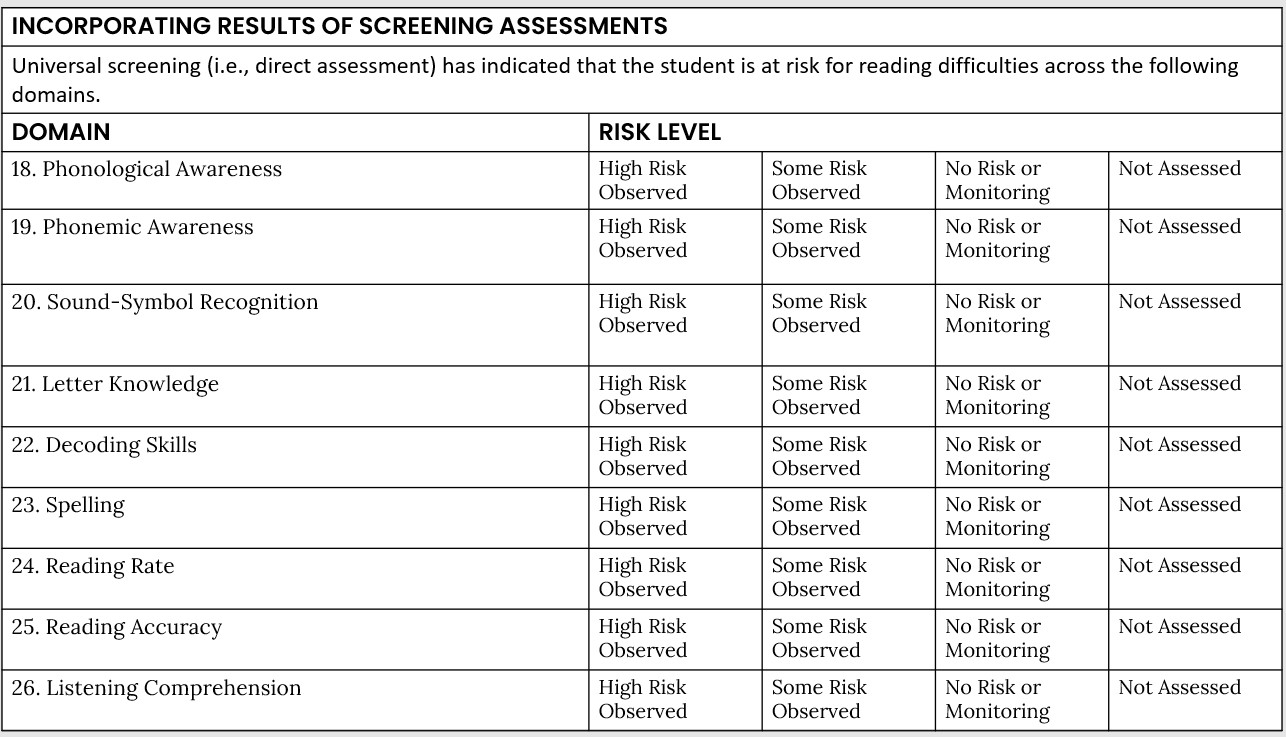
Second Grade
Notes:
*(Note: After completing the assessment, tally up the points from each column and add them together. If the student receives a score of 34 or greater, they should be considered for further evaluation to rule out reading difficulties. If you enter the scores online through CLI Engage, the score will automatically update and provide total results.)
References:
Texas Education Agency. “19 TAC Chapter 110. Texas Essential Knowledge and Skills for English Language Arts and Reading.” Texas Education Agency – 19 TAC Chapter 110. 2017. http://ritter.tea.state.tx.us/rules/tac/chapter110/index.html.
Texas Education Agency. THE DYSLEXIA HANDBOOK.
DRC Manuals
Below you can access all versions of the DRC Manuals. Each document contains a section on how the checklist was built and three appendices. The first appendix is the screening tree for dyslexia (A), followed by the checklist (B), and finally the anchor explanations (C) for each measure.
Download the DRC Manuals to use with any progress monitoring tool, or log in to CLI Engage to complete the Dyslexia Referral Checklist to track student data online.
