Chapter 4: Family Engagement in STEM
As an educator, your communication and modeling with families and caregivers can open up long-term pathways to STEM interest — more than just the short time children take part in your afterschool program. Consider three types of caregiver supports: conversation starters, extension activities, and personalized caregiver-educator conversations.
How Can Caregiver-Child Conversations Improve Learning?
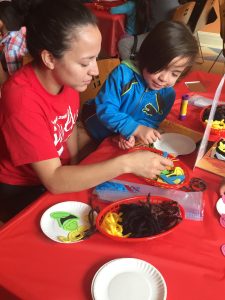
Conversations between family members and children support children’s learning across all content areas. Conversation is a simple tool available for all caregivers to use. Did you know that when children and parents talk and reminisce about their STEM explorations, it actually improves learners’ learning and long-term memory of concepts. Some ways to encourage caregiver-child conversations include:
- Encourage parents and caregivers to have STEM focused conversations about each unit or topic you explore.
- Send families a one-pager that explains the learning goals at the start of each unit.
- Text families conversation starter tips. Such as, ask your child “Tell me about the different fluids you used to make those two types of slime.”
- Explore more here: Partnering with Families
How Can Caregivers Extend Learning at Home?
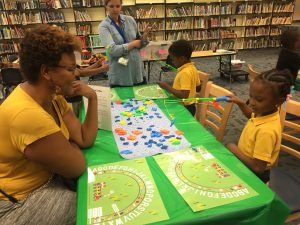
Provide at-home ideas for families to extend the learning linked to your afterschool STEM lessons. The aim is to send playful and simple ideas that spark family interest in doing math, science, and tinkering together.
- Remind families that home investigations can be done with simple household materials that children are familiar with and feel comfortable talking about.
- Share the Circle Activity Collection for Families for evidence-based activities that can be completed with common household materials.
- The collection includes developmentally appropriate at-home learning activities for preschool through elementary.
- Many activities include video examples that demonstrate how family members can effectively support children’s learning, such as this one: Let’s Bake!
- Explore more here: Encouraging Play-Based Learning and Responsive Interactions at Home
How Can Educators & Families Work to Open Pathways to STEM?
Parents and primary caregivers play a key role in explaining the value of STEM and setting positive expectations that their child can succeed in STEM.
Family engagement usually begins with personalized conversations in which educators encourage families and caregivers to extend STEM learning. This may include:
- Welcoming families to view and celebrate the products their children have created.
- Capstone events that welcome families to take part in aspects of the STEM program. Consider offering a virtual option for families that cannot attend in person.
- Invitations to museum field trips or other spaces that support STEM learning.
- Information about additional or future afterschool STEM experiences for their child.
Some caregivers may hold false beliefs about STEM. If you hear parent misconceptions, graciously explain why it is not true. For example:
- Myth: Some kids are really bright and genetically gifted when it comes to math.
- Fact: Anyone can become skilled in math because it is learned with practice.
- Myth: Girls don’t like STEM as much as boys.
- Fact: Girls find STEM interesting and relevant when presented in engaging ways.
Children are more likely to succeed in STEM and even select STEM-related careers when their families model that STEM is interesting, valuable, and hold high expectations of their child’s STEM abilities.
Chapter 4 Video Series
Engaging Families to Support STEM at Home
References
Clements, D. H., & Sarama, J. (2018). Myths of early math. Education Sciences, 8(2), 71.
Pagano, L. C., Haden, C. A., & Uttal, D. H. (2020). Museum program design supports parent–child engineering talk during tinkering and reminiscing. Journal of Experimental Child Psychology, 200, 104944.
Van Tuijl, C., & van der Molen, J. H. W. (2016). Study choice and career development in STEM fields: an overview and integration of the research. International journal of technology and design education, 26(2), 159-183.
Walsh, B. (2018, February 14). The brain-changing power of conversation. Harvard Graduate School of Education. https://www.gse.harvard.edu/news/uk/18/02/brain-changing-power-conversation
Afterschool and Schoolage STEM Toolkit
Return to the toolkit.
